Boskop Dam: No Motors Allowed

It was the 6th of March 2009. The weather man had cleared the skies for the weekend ahead. Our bosses (including girlfriends) had given us the Friday off. Everything seemed just perfect, and so “The Bass Bugger” Shaun Taylor and I hit the open road, due west towards Boskop dam near Potchefstroom in the North West Province.

Fair Enough

Fair Enough

We arrived at our destination the only 2 human beings for miles, set up our Ark inflatable almost quicker than the tent, and leapt straight into the fishing. Our first evening session was short and ended with 6 largemouth bass landed, with almost every fish taken on a weightless Stretch 40 by Gary Yamamto, a small Senko-like plastic lure with a short, finesse, ribbon shaped tail. A few were also taken on a watermelon red Super Fluke (old faithful), which is definitely my favourite for targeting bass in water that is clean to clear, such as that of Boskop dam. Once our opening evening’s session had come to an end, we retired to our camp to start a fire and throw back a few cold beers.

The next day’s fishing started off no quicker than that of the evening before. However, it was only in the afternoon that our slow day would turn frantic.  It was about 17:30 that Saturday afternoon. The cool wind brushed gently against our cheeks, whistling past our ears as we fished the clear water of a shallow bay, which I had previously had success on almost a month before. A lot had changed this time, with much of the broad-leafed surface vegetation reduced to slimy columns extending to the depths of the dam floor. The fishing seemed slower this time, as if the bass had already gorged themselves for the season on the baitfish that took refuge in the, previously flourishing, plant structure. Slow as it was, we still managed to land a good 11 fish that day, the largest barely hitting the 800 gram mark though.

Smallish Fish

Smallish Fish

As we fished our Gary Yamamoto Stretch 40’s slow and tight to the reed structure that sheltered the bay, I couldn’t help but notice the whistling in my ear growing loader and stronger. The usually solid Ark inflatable began to rock slightly on the growing, wind-inspired waves. Then it began to rock a little wilder. The black cloud which seemed dormant just a few minutes before began to move in our direction, seemingly shifting closer and closer each time we looked away to make a cast. Then the lightning flashed in the distance and the thunder grumbled threateningly. Of course our enthusiasm to coax just ONE MORE bass clouded our judgment of the entire situation, and so we stayed just a little longer, just one more cast.

Now, any angler who has ever turned their back on Mother Nature rebelliously, disregarding her warning to move indoors, will be quite familiar with the alarming crack of fork lightning just kilometers away. You know, the kind that makes the hair on the back of your neck want to pack up and leave. That was our cue. “We’re going in now Shaun” I said nervously. We reeled in our lines, pulled up the anchors and began to row back to camp, one oar for each of us. You see, Boskop dam had a recent ban on petrol powered Motors and our electric variety had run flat earlier that day. The trouble was that by this time we had allotted the wind enough time to develop from a gentle breeze into a vigorous gale, which just so happen to be pumping in the exact opposite direction to our proposed bearing of travel. Yes, we were quite literally going NOWHERE, and the blackened sky, whitened only by the frightening flashes of lightning, was rolling nearer and nearer, directly ahead of us.

Last Cast(s)

Last Cast(s)

In a confirmed panic I fashioned my tackle box into a seat, thinking that if I could take power of both oars, I might be able to row a bit more efficiently thus beating the wind.  I turned to grab the Bass Bugger’s oar, subsequently bumping my own over board. Our only chance of getting safely back to camp had literally drifted away. We were powerless as the wind blew us deeper and deeper into the bay, further and further from the sanctuary of our camp, and closer and closer to danger. At this stage I was panicked for sure. Natural selection had finally caught up to me I thought, damn you Darwin! Damn you! With lightning moving in and no way back, we were stranded in a potentially dangerous situation.  We had only one option. We let the wind blow us to the end of the bay, once we reached the bank, the Bass Bugger jumped off the front of the boat into waist high water and pulled us ashore. The next step was to make tracks for the camp and fetch the car, which we did on foot. After a decent trek along the nearest dirt road we eventually arrived at camp. We started our Opel Utility and hurried back to our lonely inflatable. At this point we could see the lost oar hung up on some vegetation in the middle of the bay. This was the tough part. The wind still howling, we dragged the inflatable up a grassy hill to the bakkie, lifted it up and placed it on the back.

Then we drove back upwind along the bank, we needed that oar. Arriving at our camp again, up wind from our floating oar, we lowered the boat back into the water, lightning still flashing around us, the thunder grumbling grumpily. Defiant of the elements we scrambled on board and pushed ourselves away from the bank. We never bothered rowing. The power of the wind was more than enough to get us back to our precious oar. At the speed at which we were moving, we had one chance to grab it from the water, and we did that magnificently. Now it was time to row back up. I sat on my tackle box and fought the elements. We were gaining ground, inch by inch. After ten minutes we were half way back. Exhausted and sweating, we noticed some fish action in our favourite spot, hmm. The wind had begun to fade, and the lightning slowed. The storm had changed direction and so we decided after our 45 minute ordeal to drop anchor and catch one more fish. And so we did.

Awesomeness

Awesomeness

As my lure splashed into the water, I could only wonder why we fishermen never learn our lesson. Or is it that we do learn our lesson but that our most primal of human instincts to survive is sometimes short circuited by the overpowering allure of pursuit for those cold blooded waterborne creatures that we call fish. I don’t know… sometimes I wonder whether we are the captor or the captured. We will leave that to you.

Vaal River Muddies and Yellow Fish

Mystic River

Mystic River

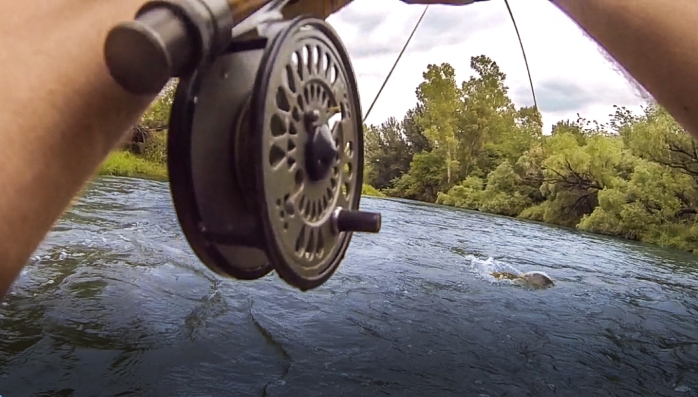
We decided to broaden our angling horizons a few weeks ago, and set out to the Vaal River with our fly rod in tow to target a species that we had not targeted before, the well sought after Smallmouth Yellowfish. The experience felt remarkably different to our usual fishing trips right from the word go. What struck me the most is that the entire process just seemed so seamless in comparison to our usual Bass fishing trips. Firstly there was no boat to lug around and pack into the bakkie, there wasn’t bags and bags of fishing tackle, nor piles of fishing rods each with its own purpose. No, it was simple, just one rod, just one small box of tiny flies, a pocket of leader/tippet materials, and a sandwich in the backpack.

After only about an hour’s drive we arrived at the river, squeezed into our waders and waded into the water anxiously. It’s an odd experience targeting yellowfish in this way for the first time. Standing in knee deep water, casting out no more than 5 meters, and allowing the fly to almost roll past my feet in the flowing current just didn’t seem right at first. But as we soon found out, it was right, in fact it was very very right. Unfortunately, other than one tiny 400 grammer, we never really caught the yellows that we set out for, but instead we found ourselves continually false hooking one of the strongest fish we have ever tackled on a light fly rod, the disgusting-looking Mudfish.  Man, as ugly as they are, I have to say that a large specimen is a force to be reckoned with, especially in the flowing rapids. Unlike their yellow counterparts (smallmouth Yellow fish), the ‘muddies’ fight downstream using the strong current to their advantage and it’s often a daunting task getting them to submit. We must have hooked into about 25 fish between us for the day but due to the fact that their sucker-like mouths are so small and turned downwards under their faces, they were primarily false hooked, which resulted in many of them breaking free under the pressure.

Bass Bugger with his first Muddy

Bass Bugger with his first Muddy

None-the-less we had one of the best days fishing that we have had in a long time, landing 10 fish between us all of which were of a decent size. I definitely think that this type of fishing is going to stick for us and we will be making regular trips down to the river throughout the summer season.

TACKLE AND EQUIPMENT

Rod: no lighter than a 5/6 weight fly rod.

Line: Definitely floating.

Leader: std 9ft leader in 2x or 3x. (attach a strike indicator to the top of the leader close to the main line).

Tippet: 2x or 3x, I prefer fluorocarbon.

Flies: nymphs and caddis imitations, copper johns. Sizes 10 to 12.

DON’T FORGET SUNTAN LOTION AND A BRIM HAT, YOU WILL BURN OTHERWISE!

Also a wading stick is essential, simply break off a broomstick and tie a rope to it. If you don’t use one, you WILL fall.

Nice Muddy, great fight

Nice Muddy, great fight

TECHNIQUES

The technique is extremely simple. I used a 3 fly tandem rig: a copper john infront, then I tied a piece of 3x fluorocarbon to the shank of the copper john’s hook and attached a slightly smaller fly to the other end, and then I attached an even smaller mustard caddis to that fly in the same way with a gap of about 20 to 30 cm between them. Simply let out about 6 meters of your line, cast it at an angle upstream and let the flies drift downstream past you. The purpose of the heavier copper john is to get the rig down to the feeding zone on the river bed. If you would prefer to use only 2 flies in tandem you could also alternately make use of a split shot to pull the flies down instead of the copper john. As the flies travel downstream follow the strike indicator with the tip of your rod and if it dips, stops or moves in any unusual manner then strike. You have to be alert though as yellowfish are renowned for inhaling and exhaling flies without one noticing. Therefore any tiny unnatural movement from the strike indicator must be reacted to. If the indicator displays no movement, simply lift the line from the water and with one cast drop it back upstream.

the only Smallmouth Yellowfish for the day

the only Smallmouth Yellowfish for the day

Whether you catch yellow fish or mudfish on the Vaal, if it is something that you have never done on fly, I can guarantee that you will be pleasantly surprised.

Dullstroom: Winter Wonderland

Always try to raise the fish's head

Always try to raise the fish's head

One of my worst times of year as an angler is UNDOUBTELDLY winter. As the fishing slows during the cold months so too does my enthusiasm toward life.  I think I speak on behalf of all avid anglers when I say that I find it difficult to keep myself busy during this time. As miserable as I become during the cold winters months there is always one place that slams a warm smile back on my face, and that place is Dullstroom. Dullstroom is an awesome little town in the Mpumalanga province where most fly fishing enthusiasts literally migrate to in the winter months in search of the illusive Trout species: rainbow, golden, and brown trout. Every so often I decide to follow, and with my gross lack of trout hunting knowledge I went up there just a month or so ago in the winter of 2009.

Beautiful Rainbow

Beautiful Rainbow

I think that Dullstroom, although a renowned and frequented fly fishing destination, has many great secrets. One of these is a small dam I’ve had the privilege of fishing on more than one occasion.  Just 5Km outside of Dullstroom the dam is seemingly unpressured and those that stay on the property have the dam completely to themselves for the duration of their stay. If there was one warning that I could share about Dullstroom it is that the temperatures drop dramatically in winter, sometimes to below zero. BUT the ‘christmasy’ atmosphere that these conditions create, are all just part of the experience for me. I love nothing more than hearing the icy grass crack underneath my shoes as I scout the dam in the early mornings, as well as watching the water from the fly line freezing into crystals around the eyes of my fly rod as I retrieve it with short sharp strips.

Rainbow trout have become one of my favourite species to target. In fact there is something about the whole culture of fly-fishing for trout that grabs me. I love sitting in front of the warm fireplace in the cottage drinking rose while I set up my rig for the following days fishing, or chopping back a castle draft in the Duck and Trout restaurant, in Dullstroom, talking about the days catch, knowing that I am constantly surrounded by like-minded anglers.

Dress Warm

Dress Warm

Now Trout fishing seems far more delicate than other fishing forms, one has to approach the dam bank with extreme care, and keep noise levels to an absolute minimum. There is something extremely peaceful about the whole experience. Anyway, some advice that I would give to the novice is as follows: Firstly, I always carry a wide variety of Woolybuggers, Red Button Wooly Worms, DDD’s, Hoppers, and especially Red Eye Damsels. The thing I like the most about trout fishing is that the fish, during winter, are visibly active during feeding time snatching falling insects off the water surface. This is the time to cast a dry fly (floating) such as the DDD to the feeding fish. You simply cast it out into the path of the fish allowing it to sit motionless, and hopefully if the fish are feeding on insects, resembled by the DDD, it should be taken fairly quickly. If the DDD does not work one could tie a Hopper pattern to the end of the line and twitch that on the water surface to entice a strike. If the fish are actively feeding on or just under the surface I generally start with a dry fly and then move to wet flies (sinking) if no takes occur. The wet flies that I almost always try are Woolybuggers in black and olive, Red Button Wolly Worms, and my absolute favourite the Red Eye Damsel, in that order. I fish all of these in the same way. I simply cast them out, allow them to sink slightly and then strip them back in short erratic movements of the wrist and forearm. If a fast retrieve doesn’t work, then I try a slow retrieve and vice versa. As far as lines are concerned I always use a floating line with a fluorocarbon leader and tippet. The more I want the fly to sink the longer I make my leader.

Another Rainbow

Another Rainbow

Trout Put up a great fight and often show amazing displays of acrobatics, just be sure to use leaders in the ranges of 3x and 4x (preferably fluorocarbon) and be gentle on the fish if possible, as during certain parts of the season they are notorious for breaking even some of the strongest of lines.

If you are interested in trying the venue that we almost always stay at in Dullstroom then please send us an email or comment on this post and we will provide you with the relevant contact details. The cottage is fantastic in its simplicity and consists of two bedrooms, a bathroom, and a beautiful fireplace. It is also situated on a hill with a stunning view. Also remember to visit the scottsman at the Mavungana fly-fishing centre as you arrive in Dullstroom for all your fly-fishing tackle and solutions.

Rho Boat…

Rho's Boat!

Rho's Boat!

Here are just a few photos of a Largemouth Bass that my young cousin Rho caught at Bass-O-Mania sometime earlier this year. It was a slow day, my uncle and I really struggled the day through catching not a single fish between us if I recall correctly. While fishing a bed of lily pads, which riddled the dam’s bank, a seemingly obvious hideout for the bass we were targeting, Rho (9 at the time) decided to cast his crawdad coloured lipless crank into the deeper water behind us. A short time after the plop he was screaming for mercy!  I thought he had got hooked up on the bottom but low and behold he seemed to be gaining line, and to our disbelief he had actually hooked into an absolute giant of a bass. I haven’t seen a rod bend like that in all the time that I have spent targeting bass.

A better indication of size.

A better indication of size.

Once he had eventually gotten the fish close enough to the boat I grabbed the fish by the lower jaw and lifted it from the water in awe. The beauty weighed in at no less than 2.4 kgs (+-5.3 pounds). Needless to say Rho seems to out fish us on every occasion, and I am certain that it must have something to do with the fact that, as older folk, we seem to think far too much about how to actually catch fish. I think that sometimes we need to just stop thinking about how to fish, and just fish.

Soaking up the rays…

beavis buthead and me...

beavis buthead and me...

I have never been the greatest saltwater angler, but have always loved it non-the-less.  Perhaps if I wasn’t brought up in the land locked city of Johannesburg It would have become my first love. Although my salt water experience is shockingly limited, I did manage to spend some time fishing the beautiful shores of Kenton on Sea and Port Alfred, during the 4 years that I spent studying in the small town of Grahamstown in the Eastern Cape.  I never caught half the species I would have liked to in all that time, but got to enjoy some of the most exquisite scenery that I reckon one can find along our coastline. Although my fish catches were hardly anything to write home about for the most part, there  was one occasion where I was pleasantly surprised.

fish on!

fish on!

I think it was around august, the year was 2007. Myself, and a few friends decided to hit Kenton main beach for the day. There was a beautiful, yet narrow, river mouth that I loved to fish in that area, so I took along a couple of rods. With a simple sliding sinker rig I tied a sardine fillet onto the hook and cast out. Within 10 minutes I was stuck into a fish stronger than anything I had hooked in the ocean before. Too my surprise a few minutes later I had landed what turned out to be the first of about 4 Blue stingrays that we managed to hook throughout the course of the day. It truly was an excellent fight, and something that I had never expected, which of course made it all the sweeter. Here are just a few pics of the blue rays we landed that day.

the "king of Kariba" with a worthy adersary.

the "king of Kariba" with a worthy adversary.

Mean Looking Guy!

Mean Looking Guy!

Flat Fish

Flat Fish